Tuesday, August 19, 2014


Lift the flap

Today we associate the concept of 'lift-the-flap' with children's books, but this anatomy text published around 1580 uses exactly the same technique.
A triple lift-the-flap, here you can first lift the skin and then lift the ribcage...
Sunday, August 17, 2014
Publishing - In the beginning


 |
| Printing presses |
 |
| Editorial office |
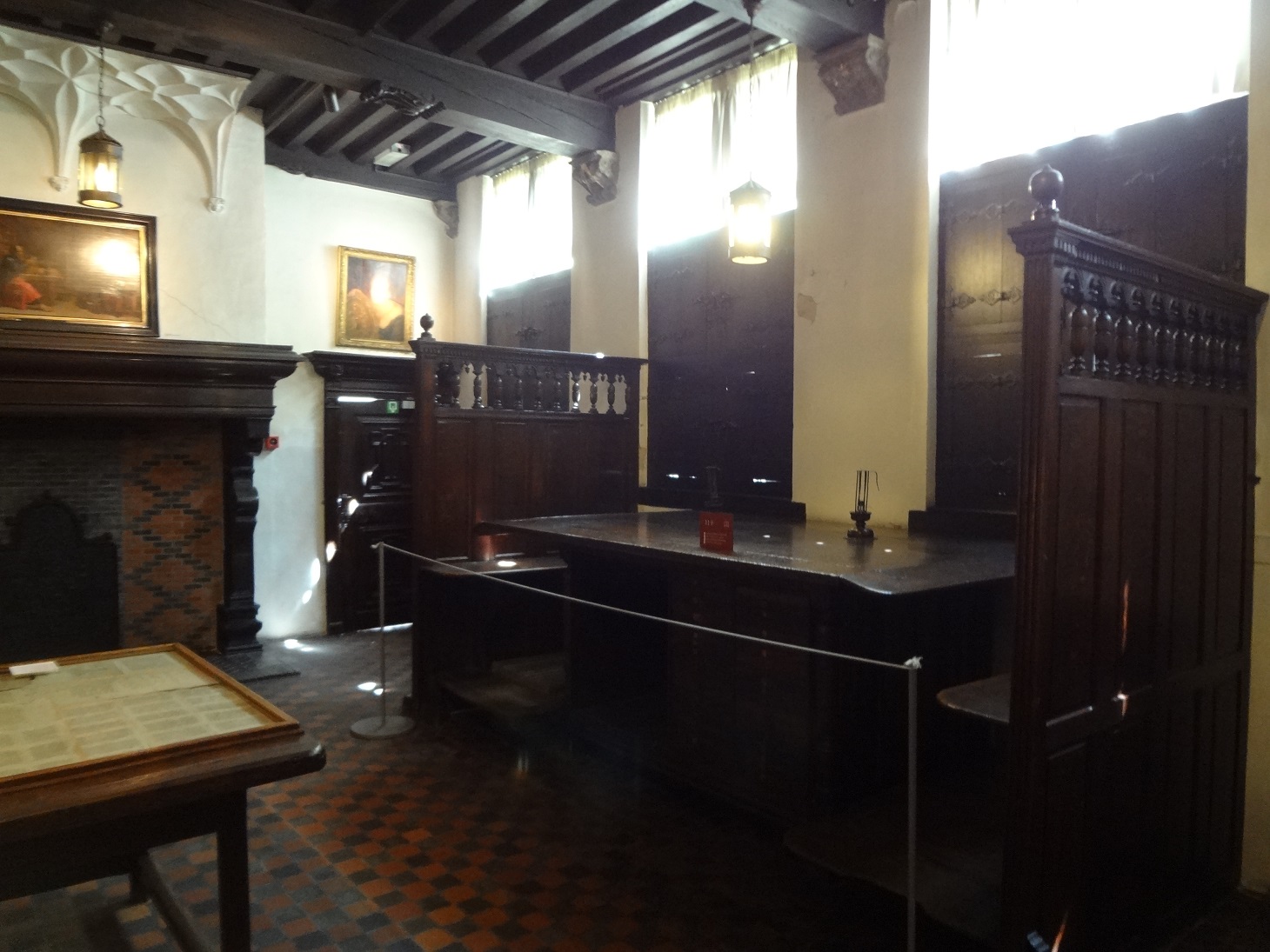
One of the reasons I went to Antwerp was to visit the Plantin-Moretus Museum. Christoph Plantin established the world's first industrial publishing and printing company in the middle of the 16th century and was succeeded by his son in law Jan Moretus. The mainstay of the company was religious texts,but they also published books on geography, history and reference, including the first 'modern' book on anatomy. Publishing up to 1876, the building was purchased by the city of Antwerp and turned into a museum.
It is amazing that this place survived so intact for so long and now houses two of the oldest printing presses, the original 17th century bookshop, two extensive libraries along with all the family's living quarters which were in the same building. Among the book collections are two Gutenberg bibles and a first edition of Mercartor's atlas.
 |
| Bookshop |
 |
| Gutenberg Bible |
 |
| Mercartor Atlas |

Wednesday, August 13, 2014
The Hurdy Gurdy Man

The instrument is played by a turning a wheel over several strings - the speed of the wheel determines the sound. In addition to the wheel, the musician also has a simple key board which strikes the strings.
 Traditionally hurdy gurdy's were a large square instrument and were played by two people, one turning the handle and the other playing the keyboard. This smaller lute shaped version become popular in the 19th century.
This guy actually made this one himself and yes I did give him some money.
And for those who don't know the song or have forgotten here is a link. There is no hurdy gurdy played on this track.
https://www.youtube.com/watch?v=dHV8Wzldlck
Tuesday, August 5, 2014
John the Baptist
In my books John the Baptist was always this tall, muscular, bearded man in a lambskin who went striking across the countryside prophesying the coming of Jesus.
So this 15th century sculpture of Jesus and John the Baptist in an Antwerp museum came as a complete surprise. John the Baptist with his mop of curls looks a like an effete 16 year old and what is all this hand holding business with Jesus? Not sure how this would have gone down with the devout Flemish burghers when first displayed.


So this 15th century sculpture of Jesus and John the Baptist in an Antwerp museum came as a complete surprise. John the Baptist with his mop of curls looks a like an effete 16 year old and what is all this hand holding business with Jesus? Not sure how this would have gone down with the devout Flemish burghers when first displayed.
Saturday, August 2, 2014
For Tintin fans
 This picture of a real estate sign in Antwerp alludes to the two detectives in the Tintin books known in the English editions as Thompson and Thomson. But there is something not quite right... what is it?
In Antwerp
 Unlike Bruges, Antwerp is a much livelier city that people actually live in and a good deal less touristy. Belgium is so small that every where is only an hour or two away by train so that is an excellent base and much cheaper city to stay than Brussels.
Once Bruges declined as a city, Antwerp flourished and during the 16th was one of the world's great cities accounting for 40% of world trade and with a population of 200,000 was the second largest city (after London) in northern Europe. However, the city sided with the Dutch rebels in 1575 and when the Spanish retook the city in the same year, 7000 people died and the city was badly damaged. The final blow was the exile of the Protestants who moved with their skills and money to Amsterdam. From that point on Antwerp suffered a steep decline and by 1800 the population was down to 40,000. Today though Antwerp is now the commercial heart of Belgium.


 The city is a very pleasant mix of historical and modern buildings, a lively shopping centre and plenty of bars and restaurants.
Naturally in Belgium you must drink Belgian beer and eat waffles, but I draw the line at the small and tasteless Belgium mussels.


Subscribe to:
Posts (Atom)